
How it works
How a dry joint works.
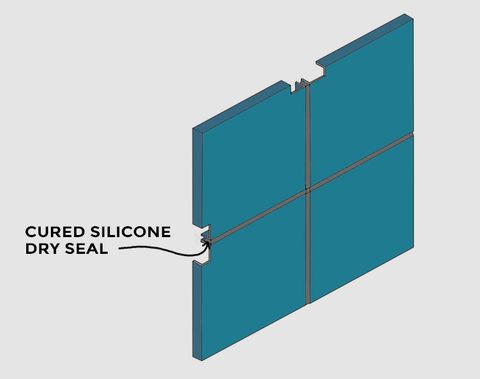
A dry joint closes the gap between facade panels with a seal that is already cured. Here is what that changes on the wall.
On site, step by step
Six steps on the wall, or one.
The usual wet sealant joint in the order it is done, against the dry joint. How the seal is fixed depends on the panel system, so talk the detail through with David before the first joint.
Wet joint
Six steps on the wall.
Dry joint
One.
01 Mask
Mask both panel faces.
01 Fit
Fit the cured seal into the joint.
02 Rod
Push a backer rod into the joint.
02
Not on this joint
03 Gun
Gun the sealant in.
03
Not on this joint
04 Tool
Tool the bead by hand.
04
Not on this joint
05 Untape
Pull the tape off both faces.
05
Not on this joint
06 Wait to cure
Leave it to cure on the wall.
06
Not on this joint
In section
The two joints, side by side.
Wet joint
Sealant over a backer rod, tooled by hand. Tape on both faces until the bead is tooled.
Dry joint
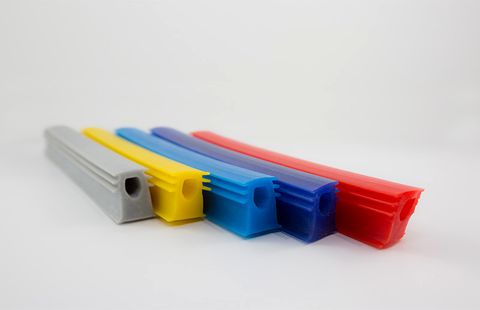
One cured silicone seal: a flush face with fins that grip the sides of the joint, many with a hollow core.
Illustrative sections at one scale, not to scale with a real joint. Profile shapes vary with the joint.
| On site | Wet joint | Dry joint |
|---|---|---|
| Backer rod | In every joint | None |
| Masking tape | On both faces, pulled after tooling | None |
| Sealant bead gunned and tooled to form the joint | Yes | No. The fixing depends on the panel system: ask David |
| Curing | On the wall, after tooling | In the factory, before it ships |
| Shape of the joint face | Set by hand when tooled | Set by the extrusion |
| Colour | Set by the sealant chosen | Set in the factory |
The material
Why silicone.
Silicone stays flexible across a wide temperature range and resists UV and weathering. That is why it has long been used on building facades, as wet sealant and as cured seals.
Those are properties of silicone as a material. For what a particular profile suits, talk to David about your joint and panel system.
Recladding and the NCC
A note on combustibility.
NCC 2022 clause C2D10(4) lists gaskets, caulking and sealants among materials that need not be non-combustible in external walls. Confirm the detail with your project’s certifier.
Does a dry joint use any sealant at all?
The seal itself arrives cured. How it is fixed depends on the panel system and the joint, so talk the detail through with David before the first joint.
Can a dry joint be used on a recladding job?
Often, yes; it depends on the panel system and the certifier. NCC 2022 clause C2D10(4) lists gaskets, caulking and sealants among materials that need not be non-combustible in external walls. Confirm the detail with your project’s certifier.
See a dry joint for yourself.
Request samples, or book a call and talk your joint through with David.